
How Arrest Warrants Work In Hayes County
Hayes County follows the same statutory path as the rest of Nebraska. Section 29-404 calls for a written complaint signed by a prosecutor or complainant and a reasonable-ground showing before anything issues. The Nebraska Judicial Branch pretrial guide lays out the rest: a sworn law-enforcement affidavit, judicial probable-cause review, a signed warrant, and a complaint filed in County Court. Section 29-406 then directs the warrant to a sheriff, a city or village marshal, or another police officer, commanding that the person be brought before the court. None of this adds up to a public roster. In Hayes County the practical method is a case search plus the register of actions, with the issuing clerk confirming any later service, recall, quash, cancellation, or superseding entry.
Hayes County Arrest Warrants: Complaint To Court
In Hayes County, an arrest warrant usually starts on paper. A complaint or affidavit lays out the basis, presented by a prosecutor or complainant. A judge or authorized clerk magistrate then makes the legal finding, the clerk files the case, and the sheriff or another directed officer handles the arrest. Those jobs stay separate by design.
- Locate the County Court or District Court case in JUSTICE.
- Read the complaint, affidavit, and register entries that are public.
- Check whether the case later moved from County Court to District Court after bind-over.
- Ask the issuing clerk about current process status, bond, and appearance instructions.
- Use an attorney for advice about a criminal appearance or surrender choice.
In Hayes County, only the issuing court can recall a warrant; the prosecutor cannot do it alone, and the sheriff serves process rather than replacing the court.
Arrest Warrants: What They Contain
A Hayes County arrest warrant file can list the issuing court, case number, charge, issuing officer, issue date, directed agency, bond terms, and return of service. What the public actually sees varies. One caution: a blank form or a general statute proves nothing about a specific case.
| Accusation | The complaint's substance or the case caption tied to the process. |
|---|---|
| Legal finding | Reasonable grounds or probable cause as required for the issuance stage. |
| Command | Direction to a sheriff, marshal, or other officer to bring the accused before court. |
| Case link | County Court at the preliminary stage or District Court after bind-over. |
| Later events | Service, return, appearance, bond, recall, quash, cancellation, or replacement. |
Hayes County Arrest Process Is Case Based
Hayes County publishes no arrest-warrant list, no local warrant-number format, and no status-code glossary. The state case-information system, JUSTICE, is the practical entry point for a public warrant lookup. Treat any result as a case trail, not a verdict. A no-result search can mean a name spelling, wrong court, indexing delay, a sealed or juvenile record, or a federal matter outside JUSTICE. The Nebraska Judicial Branch pretrial guide walks through probable-cause review, arrest warrants, complaints, bonds, and case-file access, though it promises nothing about what is online. The official page shows the state's own explanation of the pretrial process, not anyone's complaint or warrant.
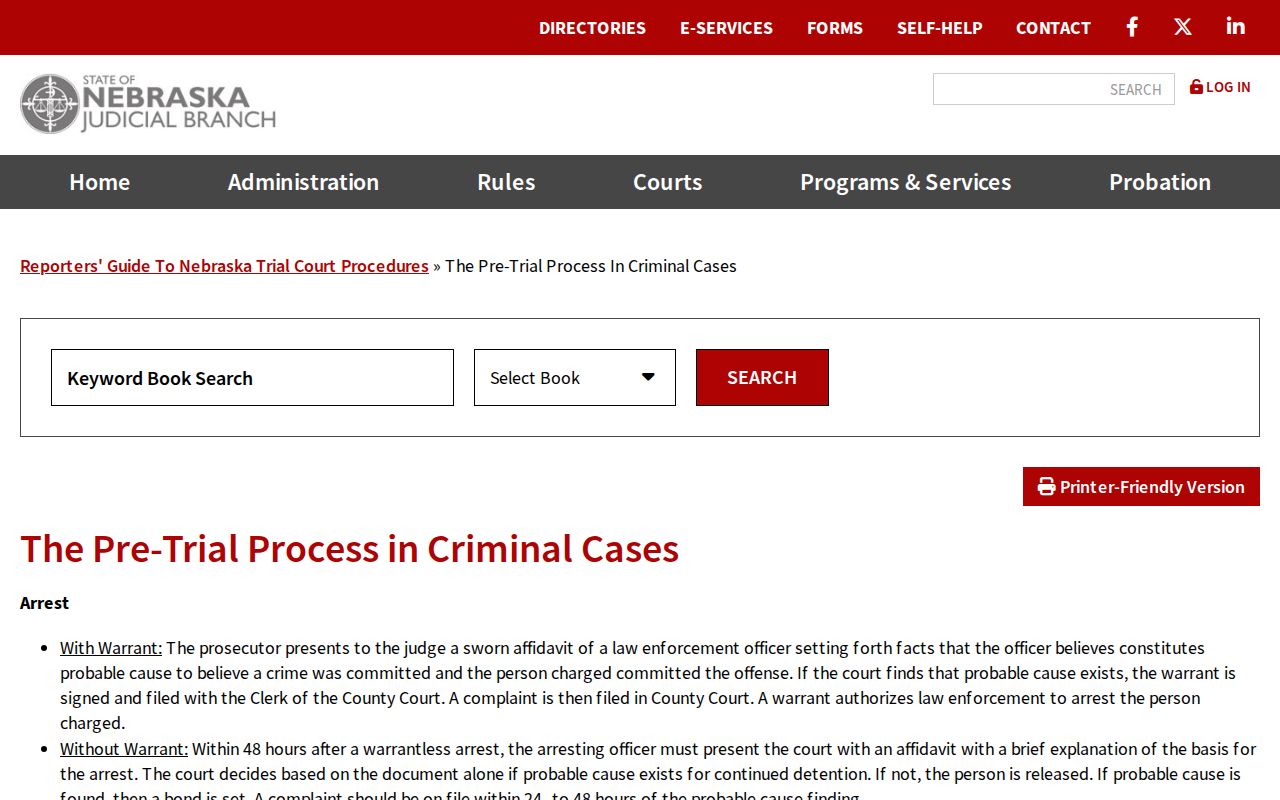
Use the process map to identify which clerk should answer the next question.
How Warrants Get Served In Hayes County
Section 29-406 lets a warrant be directed to the sheriff, a city or village marshal, or another police officer. The Hayes County Sheriff's office says it serves, executes, and returns writs and legal process and apprehends criminals. Hayes Center posts no police warrant page, marshal page, or service-return database.
Judge or authorized clerk magistrate decides whether process issues.
Clerk maintains the court record and later register entries.
Sheriff or another directed peace officer serves or arrests.
Issuing court changes the process through its order or docket entry.
The Hayes County Sheriff's published number is (308) 286-3364. Use it for routing; the office makes no same-day surrender or recall promise.
Hayes County Arrest Records Need Clerk Confirmation
An arrest, a warrant issuance, and a case outcome are separate parts of a Hayes County court file. A file can show an arrest return yet still await court action. A complaint can sit there with no public status label. Even a closed case may need the clerk to explain a process entry.
Read the latest entry: Look for service, return, recall, quash, cancellation, bond, or appearance language instead of relying on one old “warrant issued” line.
Hayes County Court answers at (308) 286-3315. District Court is (308) 286-3413, and the state directory names Susan Messersmith as clerk. Call the office tied to the case and ask what court-authorized record shows its current status.
Hayes County Arrest Warrants, Summonses, And Bench Warrants
Hayes County courts use three kinds of process, and each one starts a case differently. A summons simply asks you to show up. An arrest warrant goes further: it tells an officer to arrest the accused and bring them before the court once the required finding is made. A bench warrant, also called a capias, comes from the bench itself and usually follows a failure to appear, a failure to comply, or contempt. Docket labels blur these lines, but the papers are distinct events from day one.
| Process | Starting point | Local question |
|---|---|---|
| Summons | Notice to appear | Which court set the date? |
| Arrest warrant | Complaint and judicial finding | What accusation and court file control? |
| Bench warrant | Missed appearance, compliance, or contempt | What recall or hearing does the issuing court require? |
Hayes County District 11 Context
Hayes County sits in Nebraska Judicial District 11. The state directory currently lists a District 11 vacancy along with Judges Chawnta M. Durham, Patrick M. Heng, and Cindy R. Volkmer, and it names Patrick M. Heng as presiding judge. An older local page still names David Urbom, so treat current state information as controlling over stale local text. None of that changes the practical route for a warrant question. Susan Messersmith remains the published Clerk of the District Court, reachable at (308) 286-3413 and clerk@hayescounty.ne.gov through the state directory. Ask the clerk for the public district file rather than relying on a judge's name lifted from an old page. The current Hayes District Court page confirms the court's contact details and office setting, and it stands as a court reference rather than an arrest-warrant list.
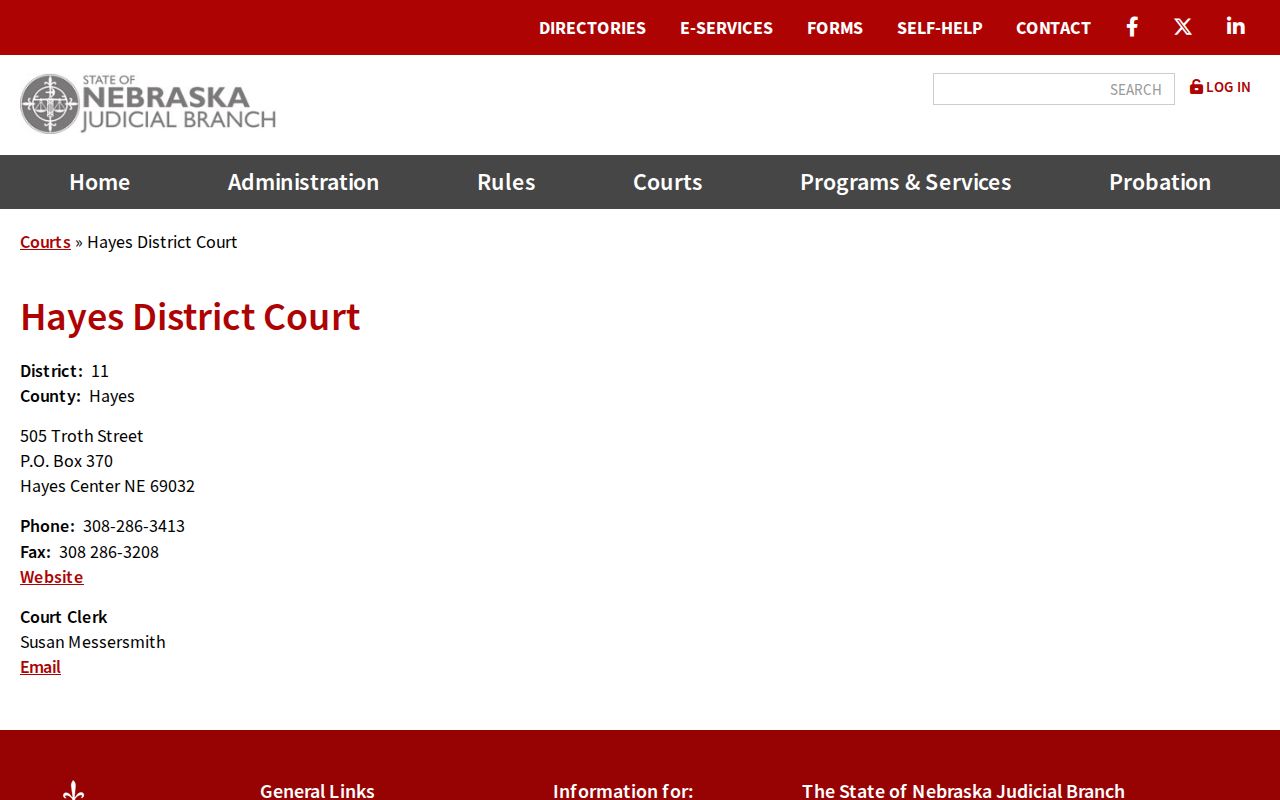
Use current clerk information when an older local page conflicts.
Handling An Arrest Warrant In Your Name
So a Hayes County warrant search turned up an arrest warrant in your name. Call the issuing clerk first. Ask for the case number, the current status, any bond or release instruction, and how you must appear. A lawyer can then help you weigh the options. A motion, a voluntary appearance, posting bond, or another court step may fit, depending on the case. Hayes County has no published universal surrender, after-hours, or bond-window procedure, so confirm the process case by case. One warning deserves emphasis. Never pay through a link sent by a caller or a text. Nebraska courts say plainly that they do not serve arrest warrants electronically or demand money through common transfer apps, so verify any notice by calling an official court or sheriff number you find yourself. After you act, ask when the docket will reflect a recall or other change. Keep the order or receipt. Payment alone is not proof of recall.
Hayes County Access Limits
Access to Hayes County warrant material depends on the type of record. Adult arrest-warrant papers can enter a public court file once charges are filed, though sealing and other limits still apply. Search-warrant affidavits sit under a separate secrecy rule before execution. Juvenile records, protected identifiers, and active-investigation material may be withheld or redacted. A federal sealed warrant belongs to a different court system entirely.
Records rule: A no-result or withheld document is not proof that no process exists. Ask the clerk what public portion and review route are available.
The statutes set the boundaries. Nebraska sections 84-712 and 84-712.05 govern public-record requests in Hayes County, section 43-2,108 protects juvenile records, and section 29-817 covers search-warrant secrecy. Match the rule to the record type.
Hayes County Court Leadership Update
Court leadership in the region is shifting. A September 2026 Judicial Branch release names two applicants for the District 11 vacancy and sets a public hearing date; the official vacancy release carries that current development. None of it changes the clerk's public contact route, and Hayes County readers still need to verify any case-specific process with the issuing court. Treat the release as leadership news, not as evidence of an arrest warrant or a change to a case.
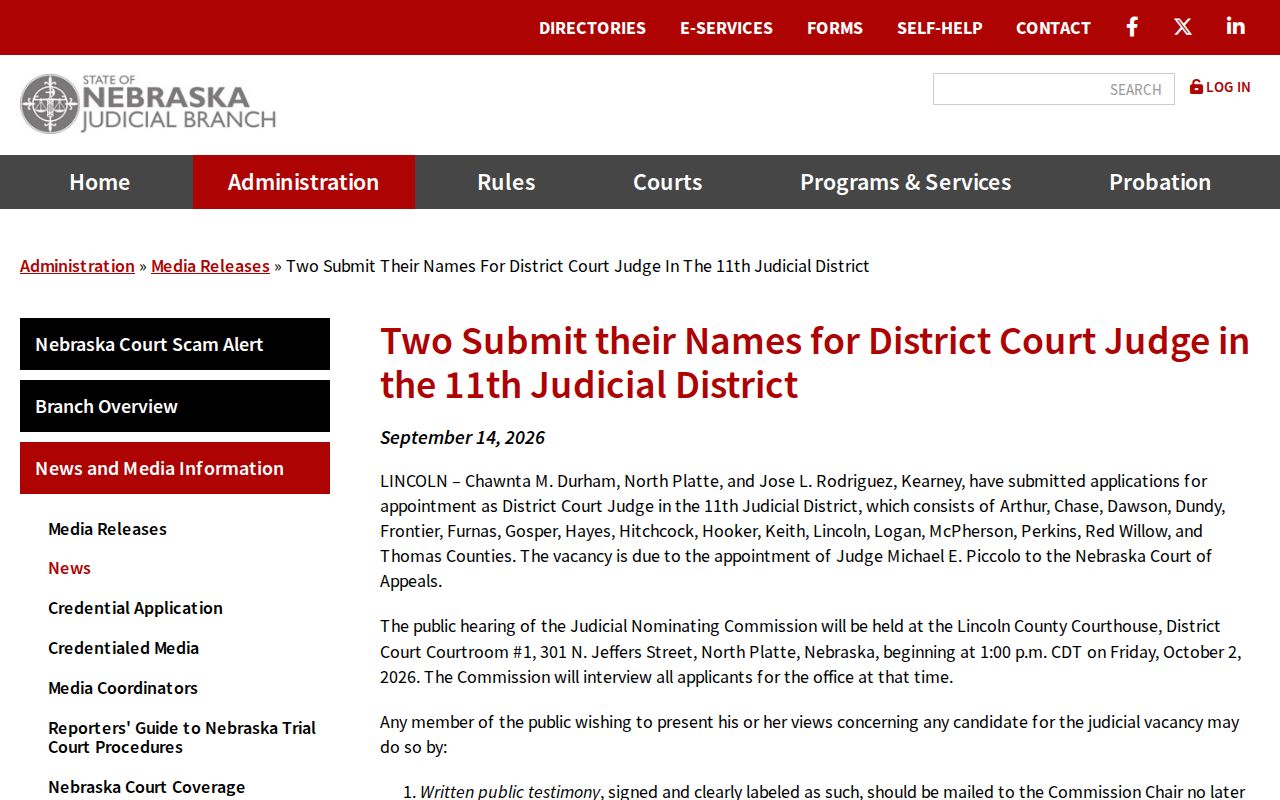
The update is court-administration context, not a live status source.